Headlines from Harvard’s history

“Vagabonding,” Harvard Student Agencies, and more from the Harvard Alumni Bulletin and Harvard Magazine

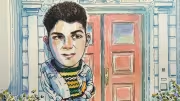
Illustration by Mark Steele

1927

“To vagabond,” i.e. “to rove around classrooms where one does not belong,” has entered the undergraduate vernacular. The Bulletin reports a noticeable increase in the practice during the fall, in part because Crimson editors have begun printing daily lists of lectures deemed to be of general interest.

1942

Thirty-nine members of the Harvard Auxiliary Fire Department, organized to supplement the regular Cambridge department in case of fire from enemy air attack, receive their badges at a special dinner with University officials and Cambridge firemen.

1947

The Band expresses student opinion on a suitable World War II memorial by spelling out “Harvard Needs a Student Activity Center” during half time at the Princeton game.

1952

Oliver Bolton ’39 (R-Ohio) is elected to Congress, joining his mother, Frances Payne Bolton (re-elected for a seventh term), as the first mother-and-son representatives in U.S. history.

1957

Harvard Student Agencies Inc. has been chartered as a private nonprofit Massachusetts corporation. HAS plans to work closely with Harvard financial-aid officers to assist needy students by encouraging and helping to organize student-conducted business enterprises.

1962

A bequest from bacteriologist and immunologist William A. Hinton ’05, M.D. ’12, Harvard’s first black professor, has set up a Dwight D. Eisenhower Scholarship Fund for graduate students, to recognize that administration’s accomplishments toward acceptance of the principle of equal opportunity for all.

1967

Meeting at Harvard, the National Association of Graduate School Deans unanimously proposes scrapping existing selective-service laws in favor of a lottery.

1992

Tommy’s Lunch, “a Mount Auburn hangout for generations of Harvardians,” closes its doors on Thanksgiving weekend, without fanfare, after 35 years of feeding hungry undergraduates.
Related topics

You might also like

250 Years Ago, Harvard Was Home to a Revolution

A look at the sights, sounds, and characters that put the University on the frontlines of history

The Framer Who Refused to Sign the Constitution

Harvard’s Elbridge Gerry helped draft the U.S. Constitution, but worried it might create a new monarch.

How the American Revolution Freed a Future Abolitionist

Darby Vassall, an enslaved child freed after the Battle of Bunker Hill, dedicated his life to fighting for liberty.

Most popular

How physical appearance influences authority

Cherubic features benefit black male CEOs, but not other groups, underscoring the complexity of social disadvantage.

How Women Are Changing the NBA

From coaching staffs to front offices, female leaders are bringing new strategies to men’s basketball.

Harvard Law Professor Explains the AI Battle Between Tech and Government

Jonathan Zittrain compares today’s conflicts to tensions surrounding the early internet.

Explore More From Current Issue

Four stylized magnifying glasses arranged in a gradient background with abstract patterns.

AI Hunts For Stolen Harvard Coins

A museum curator and a computer scientist track down ancient coins taken in a legendary heist.

Woman with long hair, smiling, wearing a black sweater, in a textured beige background.

For This Poet, AI is a Writing Partner

Sasha Stiles trained a chatbot on her manuscripts. Now, her poems rewrite themselves.

Portrait of a man with white hair, wearing a black coat, arms crossed, thoughtful expression.

The Framer Who Refused to Sign the Constitution

Harvard’s Elbridge Gerry helped draft the U.S. Constitution, but worried it might create a new monarch.