Headlines from Harvard’s history

Headlines from Harvard’s history

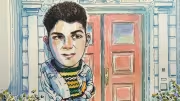
Illustration by Mark Steele


1933

Permission for a pacifist meeting of the Harvard Liberal Club on the Widener steps on Armistice Day is denied by President Conant because “the courtesies of the Yard have already been extended” to West Point cadets in Cambridge for the football game. (Army won, 27-0.) The Widener steps, he adds, are available between 9 and 9:30 a.m., as are Harvard buildings outside the Yard throughout the day.

1938

Complaints by patients of Stillman Infirmary about “class D detective stories” have prompted the hygiene department, University library, and financial office to pledge $100, with a promise of $50 each succeeding year, until Stillman’s literary offerings are more acceptable.

1948

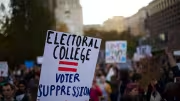
In a University-wide straw poll conducted by the Crimson, challenger Thomas Dewey defeats President Harry Truman 1,897 to 833. Faculty members pick Dewey five to one. Undeterred, the Crimson endorses Truman.

1953

The Band, en route to the Columbia game, gives a 3 a.m. concert at Yale that is cut short by the arrival of 12 New Haven police cars. Band manager Peter Strauss ’54 and a colleague are booked for disturbing the peace.

1968

Fury erupts at a December 3 faculty meeting when philosophy professor Hilary Putnam introduces an anti-ROTC resolution. Unusually high attendance has forced the meeting to be held in Sanders Theatre; outside, 250 students hand out leaflets and shout, “ROTC must go.”

1988

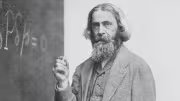
The University’s Association of Black Faculty and Administrators calls for an affirmative-action plan, involving recruitment and a capital campaign, to ensure that blacks, Hispanics, and Native Americans comprise 10 percent of its faculties by 1990, the centennial of the College graduation year of W.E.B. Du Bois, who became Harvard’s first black Ph.D. recipient in 1895.
Related topics

You might also like

250 Years Ago, Harvard Was Home to a Revolution

A look at the sights, sounds, and characters that put the University on the frontlines of history

The Costly Choice Native Americans Faced

How the Revolution reshaped indigenous New England

The Harvard-Trained Doctor Who Urged a Revolution

Before his heroic death, General Joseph Warren was dubbed “the greatest incendiary in all of America.”

Most popular

Harvard Answers Government Admissions Lawsuit

In a separate case, the Trump administration outlines its argument for the federal funding freeze. 

Harvard Law Professor Explains the AI Battle Between Tech and Government

Jonathan Zittrain compares today’s conflicts to tensions surrounding the early internet.

At Harvard, Mitt Romney Warns Against ‘Authoritarian’ Presidential Power

The former senator touched on polarization, tech governance, and diplomacy during a conversation at the Institute of Politics.

Explore More From Current Issue

A woman in glasses gestures while speaking to two attentive listeners at a table.

How to Cook with Wild Plants

From wild greens spanakopita to rose petal panna cotta, forager and chef Ellen Zachos makes one-of-a-kind meals.

A dancer in a black leotard poses gracefully in a bright studio, with mirrors reflecting her movement.

A New ‘Black Swan’ Musical Cranks Up the Tension

The creative team of the A.R.T.’s new show dish on adapting Darren Aronofsky’s thriller classic from screen to stage.

Portrait of a man with white hair, wearing a black coat, arms crossed, thoughtful expression.

The Framer Who Refused to Sign the Constitution

Harvard’s Elbridge Gerry helped draft the U.S. Constitution, but worried it might create a new monarch.