Headlines from Harvard’s history

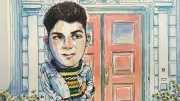
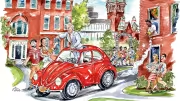
Demonstrating for equality…and other headlines from Harvard’s history

Illustration by Mark Steele

1929

The Law School’s Institute of Criminal Law opens, to study practical ways—including consultations with psychiatrists, social workers, and doctors—to deal with criminals, as “mere punishment…does not yield adequate results.”

1954

Half a year after defending Harvard against Senator Joseph McCarthy, President Nathan Pusey draws more than 500 people to the National Press Club’s luncheon in his honor; his speech on “Freedom, Loyalty, and the American University” and his willingness to answer all questions earn a “remarkable ovation.”

1969

Eighteen students have signed up to concentrate in the newly created field of Afro-American studies.

A representative of Students for a Democratic Society receives last-minute permission to speak at the Morning Exercises, and attacks Harvard, calling the Commencement ceremony “an obscenity” and “an atrocity.” Subsequently, he, about 30 seniors, and some hundred others walk out to hold a brief counter-Commencement and listen to an address by philosophy professor Hilary Putnam.

1974

About 125 Radcliffe seniors organize a demonstration during Commencement week, wearing armbands, placards on their backs sporting equal signs, and bright yellow ribbons atop their caps. Their four demands are: equal admissions; equal job opportunities; equal facilities and finances for athletics; equal distribution of fellowship funds.

1979

The success of National Lampoon’s Animal House prompts Universal Pictures to offer $500 to sponsor a toga party in South [Cabot] House. Dean of students Archie Epps vetoes the proposal.

1989

South African archbishop Desmond Tutu, LL.D. ’79, running as a petition candidate for Harvard-Radcliffe Alumni Against Apartheid, gains a seat on Harvard’s Board of Overseers.
Related topics

You might also like

The Woman Who Penned the Case for War

Mercy Otis Warren’s poetry and plays incited the Patriot movement.

The Harvard-Trained Doctor Who Urged a Revolution

Before his heroic death, General Joseph Warren was dubbed “the greatest incendiary in all of America.”

The Framer Who Refused to Sign the Constitution

Harvard’s Elbridge Gerry helped draft the U.S. Constitution, but worried it might create a new monarch.

Most popular

250 Years Ago, Harvard Was Home to a Revolution

A look at the sights, sounds, and characters that put the University on the frontlines of history

Martin Nowak Placed on Leave a Second Time

Further links to Jeffrey Epstein surface in newly released files.

A New ‘Black Swan’ Musical Cranks Up the Tension

The creative team of the A.R.T.’s new show dish on adapting Darren Aronofsky’s thriller classic from screen to stage.

Explore More From Current Issue

White House and Harvard University buildings split diagonally with contrasting colors.

Harvard Weathers a Year of Turmoil

The federal government has launched unprecedented actions against the University. Here’s a guide.

Woman with long hair, smiling, wearing a black sweater, in a textured beige background.

For This Poet, AI is a Writing Partner

Sasha Stiles trained a chatbot on her manuscripts. Now, her poems rewrite themselves.

Brick archway with a sandy base, surrounded by wooden planks and boxes in a dim space.

How the American Revolution Freed a Future Abolitionist

Darby Vassall, an enslaved child freed after the Battle of Bunker Hill, dedicated his life to fighting for liberty.