|
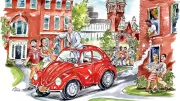
"Your wooden arm you hold outstretched to shake with passers-by." |
Turkeys are menacing innocent students at the Business School. “Large female wild turkey…trots after male Business School student around several buildings, finally stopping when the student runs into the Baker Library for cover,” reports the Harvard Recycling Update, a monthly e-mail bulletin on refuse and campus wildlife sightings.
Harbus, the school’s student newspaper, is much energized by the turkeys, of whom there are at least two. Why are the turkeys here? Writes an editor, “It is doubtful that, like many of us, the turkeys are here to find rich husbands, international-style squash courts, or decent sushi,” adding darkly, “Here they are only safe until someone works out the NPV [net present value] of the purchase of a good stout ax and some gravy.”
Maybe, but the turkeys are good at intimidation. “Apparently, much like labor unions, they will back off if you act aggressively,” Harbus counsels, “but…that is not as easy as it sounds. These birds fight back….”
“Parables of the Wild Turkey” appear in successive issues of the paper as the gobblers take up residence in students’ imaginations, too. In one parable, the turkey sneaks into the dean’s residence and then flees five minutes into one of his uninterrupted dinner-table disquisitions. “Moral of the story: Nobody can stand an uninspiring monologue.” In another, the turkey downs an M.B.A. candidate on the lawn and pecks his forehead so relentlessly that the man misses a job interview. Moral: “The wild turkey can save you from a wretched life as a McKinsey consultant.”
Hunters had exterminated wild turkeys in Massachusetts by 1851, according to an advisory in the Boston Globe, but today, thanks to governmental intervention, the Commonwealth harbors an estimated 20,000 of the peripatetic fowls.
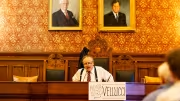
Remembrances: One of the more agreeable behaviors of the Faculty of Arts and Sciences is the delivery of “Memorial Minutes” at faculty meetings. These are tributes to deceased colleagues written by committees of their friends and “spread upon the minutes” of the faculty for eternity. They often include material not found in the usual obituary. We are told, for instance, that one of the greatest legacies of the late statistician Charles Frederick Mosteller, LL.D. ’91—who brought his learning to bear in a zillion disciplines—“is his impact on others through collaboration, and he famously accumulated a host of co-authors across many fields.” A poem read on his seventieth birthday begins: “On a high and secret mountain on a South Pacific isle/Lived a hermit in a mud house in a most reclusive style/ He had not clothes nor money, neither dishes nor a bed./ And he had never even written one short monograph with Fred.”
Of the late economist John Kenneth Galbraith, LL.D. ’88, his colleagues noted that, “Unlike most Harvard professors, he used personal stationery headed simply ‘John Kenneth Galbraith, Cambridge, Massachusetts’; the post office knew where to find him.”

Nicety: For ages, the Harvard Glee Club has burst into the anthem that begins “Domine, salvum fac Praesidem Nostrum…” whenever the president of the University appears on a state occasion. The words mean “O Lord, make safe our president,” and their 1853 setting by composer Charles Gounod constitutes Harvard’s equivalent of “Hail to the Chief.”
Glee Club members perceived, of course, that the words would require declensional adjustment because of the gender of the new incumbent. Thus, at a gala in Chicago last fall to celebrate the 150th anniversary of that city’s Harvard Club (the oldest of the clubs), when President Drew Gilpin Faust entered the hall, the words rang out, “Domine, salvam fac Praesidem Nostram….” “She recognized the change, laughed, and turned around to smile at us,” says Glee Club manager Kelby James Russell ’09. “It seemed rather remarkable that anyone noticed the change at all.”
~Primus V