
Hired in 2003 to build the capacity of Harvard’s African languages program (last spring it offered 21 of them, more than any other university in the world), John Mugane, professor of the practice of African languages and cultures, soon noticed a category of students who picked up one tongue after another without much difficulty, traipsing glibly among language families, from Nilotic to Bantu to Khoisan. After keeping a close eye on these polyglot students for several years, Mugane is writing a set of annotated language-learning textbooks based on their habits. (Igbo, spoken in Nigeria, is the first test case.) The skills, which he will summarize in a separate book, Learning How to Learn Languages, include repetition, note-taking (particularly writing down new phrases one hears in conversation), listening for idiomatic turns of phrase, and focusing on utility rather than flawless grammar. A capacity for independent learning is particularly handy with African languages: because many have no formal written grammars or textbooks; because it can be hard to find fluent speakers in the Boston area to hire as teachers; and because unrelated languages so commonly exist in close proximity on the continent. But Mugane—who grew up speaking Gikuyu, Swahili, and English in Kenya, and declines to say how many languages he speaks now—believes all language instructors have a responsibility to guide students toward the skills that will make it easy to learn any language. And he believes that textbooks—even his—should serve more as references than as road maps for teaching. By nature, “textbooks are linear,” he says; language learning is not.
Professor John Mugane directs Harvard’s African language program
Meet the director of Harvard’s African language program.

John Mugane | Photograph by Rose Lincoln/Harvard News Office
You might also like

How Philosophy at Harvard Saved Itself
As humanities shrink across higher education, one department is flourishing. Is its success a fluke, or a roadmap?

The Year a Beat Poet Squatted at Harvard
In 1954, Gregory Corso moved into Eliot House. How he stayed there is a literary legend.
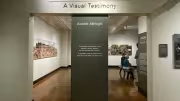
At Harvard’s Peabody Museum, Photos Reimagine Iranian History
Artist Azadeh Akhlaghi reconstructs moments of Iranian political upheaval in a series of meticulously staged images.
Most popular



Explore More From Current Issue

The Harvard triathlete and coach says she helps normal people to “do extraordinary things.”

Harvard researchers investigate climate’s impact on cocoa crops, innovations in nasal vaccines, and links between pain and skull marrow.

A rare Egyptian mummy case is on display at the Harvard Museum of the Ancient Near East.