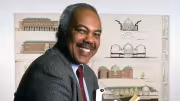
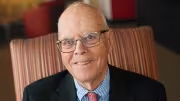
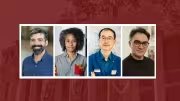
David Bisno ’61 has time on his mind these days – timekeeping, that is, as well as a mini-museum of horology that he has inaugurated in the clock tower of the picturesque Santa Barbara Courthouse. Thanks to “a confluence of opportunities,” the retired ophthalmologist, who has spent much of the last two decades promoting lifelong learning, was able to bring together an architect, an artist, a clock collector, a historian, and a cadre of volunteers to turn a large neglected storeroom into a mural-filled gallery and a showcase for the 1929 Seth Thomas pendulum clock that is a landmark in the community.
The project got its start in spring 2010, when Bisno, who divides his year between Santa Barbara and Hanover, New Hampshire, was still in California and teaching an adult education course called “It’s About Time.” One of his students, a docent at the courthouse, invited him to go behind the scenes to see the building’s historic clock, which had been telling time nonstop for more than 80 years. Housed in a room filled with cleaning supplies, it nevertheless offered a life-size lesson in horology. “Because of its size, you can see the gears,” Bisno says, which are connected to rods that extend out to the four faces. Standing there, “you are actually ‘inside’ the clock.”
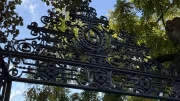
The courthouse itself is a visitor attraction, thanks to its fantastic Spanish-Moorish architecture, flamboyant tile work, and a courtroom painted with scenes from California history by a Hollywood set designer named Dan Sayre Groesbeck. Wouldn’t it be splendid, Bisno thought, to add the tower clock to the list of sights.
That was possible, he realized a few weeks later, when he met Dick and Maryann Schall, who have a world-class collection of timepieces and were willing to underwrite some of the costs of creating a museum. With the approval of the courthouse architect, the Bisno-Schall Gallery was born.
Bisno says his interest in the history of science goes back to his undergraduate days at Harvard. Though he went to medical school and practiced as an eye surgeon, he returned to campus in 1992 as a special student and visiting fellow, this time with history of science as a primary focus. “It was a fabulous year,” he remembers. “Harvard changed my life and gave me a second career.”
Among his teachers was William Andrewes, then Wheatland curator of the Collection of Historical Scientific Instruments, who was putting together an international symposium on longitude. Bisno volunteered to help, cementing an association that was renewed when Andrewes agreed to act as historical consultant for the gallery.
For the murals, Bisno hired artist Ed Lister to paint scenes depicting the story of timekeeping, from early devices and portraits of inventors up to the installation of the courthouse clock. Then, with the Seth Thomas works cleaned and refurbished, the gallery opened to visitors in April.
Bisno and Andrewes have begun to plan an International Symposium on Public Time, to be held in Pasadena in November 2013. “We’ll invite horologists from around the world,” Bisno says, adding that the gallery will be on the itinerary. The clock is ticking.