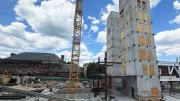
Harvard plans to build a data-science institute in Allston to support research, education, and entrepreneurship in what University leaders call “a new discipline.” Data science is central to research in public health, the physical, social, and biological sciences, and medicine; it has become increasingly important in all fields that involve empirical research, such as law, government, and even the study of culture. The institute would provide a commons for collaboration among almost every school—especially the Harvard Paulson School of Engineering and Applied Sciences (SEAS, which will have a new home on Western Avenue by 2020), Harvard Business School, the i-lab incubator and its affiliates—and research-intensive businesses that the University expects to attract to its Allston “enterprise research campus.” (For an overview, see “Why ‘Big Data’ Is a Big Deal,” March-April 2014, page 30.)
Harvard has the ingredients needed to do “world-leading data science,” said Colony professor of computer science David C. Parkes, area dean for computer science in SEAS, and co-director of the data-science initiative defining the path to an institute, together with professor of biostatistics Francesca Dominici, senior associate dean for research at the Harvard Chan School of Public Health (HSPH). Harvard has “methodologists; compelling applications questions; and…the context of society. That is the magic triangle,” Parkes said. With leading professional schools and affiliated hospitals, each with its own data-science expertise, the University has many resources already in hand. “We need to somehow bring them together,” he said, “and go from this distributed excellence” to creating a place where the people and their skills “sing together.”
The initiative plans several early steps: creating an interdisciplinary postdoctoral fellows program in which each fellow works with multiple faculty members; outfitting new programmatic spaces—one in Cambridge and one in Boston (“to help us bootstrap what we want to be,” Parkes said, “until we get to a permanent space”); and hiring professional data scientists to work with students and faculty members.
These moves complement the launch of three data-science master’s programs, one each at HSPH and Harvard Medical School, launching this fall; and one in the Faculty of Arts and Sciences beginning in fall 2018.
Dominici and Parkes declined to compare Harvard’s data-science plans to those elsewhere, or to put a timeline on the physical data-science institute in Allston. But Dominici said, “I think we are going to end at an unprecedented scale and a most important impact.” Read a complete report at harvardmag.com/datascience-17.