Visiting Dumbarton Oaks Jugglers Tale Exhibition

“Juggling” literary history at Dumbarton Oaks

(Click on arrow at right to see a gallery of images.) The stained-glass image of the juggler, commissioned for the exhibition, from Atelier Miller, at the entry to Dumbarton Oaks

Image courtesy of Dumbarton Oaks Research Library and Collection

Viewing film and television versions of the juggler's tale

Image courtesy of Dumbarton Oaks Research Library and Collection

Dumbarton Oaks has worked hard to make the juggler exhibition child-friendly.

Image courtesy of Dumbarton Oaks Research Library and Collection

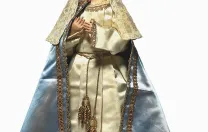
Many of the objects on display are books or related printed materials, but the tale involves the Virgin, who is rendered sculpturally, too.

Image courtesy of Dumbarton Oaks Research Library and Collection

The story has traveled into an almost bewildering array of media, cultures, and languages, carefully exhibited here.

Image courtesy of Dumbarton Oaks Research Library and Collection

The juggler is often depicted as a dextrous tumbler, as shown here, and…

Image courtesy of Dumbarton Oaks Research Library and Collection

…is rewarded for his devotion by the Virgin's grace.

Image courtesy of Dumbarton Oaks Research Library and Collection

The earliest known illustration of the juggler, in a manuscript dating from before 1268, as he performs acrobatic feats before the seated Mary, who holds the baby Jesus; a limestone pilaster with an acrobat, c. 1150-1170, from the Metropolitan Museum of Art's Cloisters collection; and an instrument that would have been used in period entertainments

Image courtesy of Dumbarton Oaks Research Library and Collection

The exhibition radiates along corridors from the central Byzantine Courtyard.

Image courtesy of Dumbarton Oaks Research Library and Collection

Franco-American artist Arman interpreted Le jongleur de Notre Dame in a 1994 bronze sculpture that is a modified replica of an antique bronze figure juggling eight lamp fixtures.

Image courtesy of Dumbarton Oaks Research Library and Collection

Medieval-styled oak benches are at hand on which visitors, especially young ones, are invited to sit to read copies of the children's books interpreting the juggler's tale—the original art for several of them is on display in the surrounding exhibition.

Image courtesy of Dumbarton Oaks Research Library and Collection

Return to main article:

The “Juggling the Middle Ages” exhibition, now open at Dumbarton Oaks, in Washington, D.C. (through February 28), plumbs the history of a medieval tale of a juggler’s devotion to the Virgin Mary; its rediscovery in 1873 and 1888 thanks to French medieval literary and philological studies; its subsequent popularization by Anatole France in 1890; and the utterly unlikely resonances and persistence of the tale today—from an American television version associated with Fred Waring (he of the Waring Blendor fame), to a staged version featured in Ebony and an operatic interpretation by W.H. Auden (The Ballad of Barnaby), illustrated by Edward Gorey ’50.

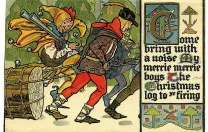
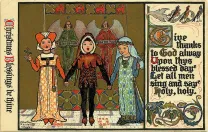
This almost madcap exploration through literary history has been lovingly conducted, curated, and brought to exhibition by Porter professor of medieval Latin Jan Ziolkowski, now in his third five-year term as director of the Dumbarton Oaks Research Library and CollectionHarvard Magazine has covered the underlying research and the astonishing reach of Ziolkowski’s collecting—of information and objects (ranging from sculpture to Christmas cards to children’s books based on the juggler story by Barbara Cooney, R. O. Blechman, and Tomie dePaola—the latter two of whom will speak at events being held in connection with the exhibition).

Visitors will find the exhibition radiating into four spaces from the Dumbarton Oaks entry, which is dominated by a newly commissioned stained-glass-window interpretation of the juggler, complete with vivid, three-dimensional yellow juggling balls. The history of the tale itself, in its medieval context, unfolds in a corridor to the left; that gives on to the great Byzantine room, now taken over, temporarily, by juggler exhibits, screenings of Blechman’s animated version of his story, plus TV and movie clips, and a collection of children’s books for visiting kids to read—while seated on oak benches inspired by medieval designs. A gallery next to the central hall features a number of those children’s books and other interpretations, including some of the original art later reduced for printing; miniature-book versions; and a lovely Jacob the Juggler, unlikely to be known to American audiences (translated by Ziolkowski and reprinted with support from Dumbarton Oaks), by the Swiss author Max Bolliger, stunningly illustrated with woodcuts by Czech-born artist Štěpán Zavřel. The perpendicular corridor is strong on operatic and other derivatives.

A final gallery, off the main reception room, captures the strong influence of medieval culture (of which the revival of the juggler’s tale was a part) on nineteenth- and twentieth-century arts, design, and books (and such sundry collateral products as advertisements for Pabst beer). It is good to be reminded that Henry Adams, A.B. 1858, included a translation of the juggler poem in Mont-Saint-Michel and Chartres. It is astonishing to see a 1906 version of The Song of Roland, from Houghton Mifflin, published in the form of a medieval illuminated manuscript: hard to imagine in the e-book era.

To anyone interested in the origins and dispersion of literature, its history, or the reach and potential of curiosity-driven humanistic research, these are among the rewards aplenty on display in Dumbarton Oaks’s magnificent spaces.

 

Read more articles by John S. Rosenberg

You might also like

Novelist Lev Grossman on Why Fantasy Isn’t About Escapism

The Magicians author discusses his influences, from Harvard to King Arthur to Tolkien.

England’s First Sports Megastar

A collection of illustrations capture a boxer’s triumphant moment. 

Rachel Ruysch’s Lush (Still) Life

Now on display at the Museum of Fine Arts, a Dutch painter’s art proved a treasure trove for scientists.

Most popular

Why Men Are Falling Behind in Education, Employment, and Health

Can new approaches to education address a growing gender gap?

The 1884 Cannibalism-at-Sea Case That Still Has Harvard Talking

The Queen v. Dudley and Stephens changed the course of legal history. Here’s why it’s been fodder for countless classroom debates.

Harvard Students, Alumna Named Rhodes and Marshall Scholars

Nine Rhodes and five Marshall scholars will study in the U.K. in 2026.

Explore More From Current Issue

Two bare-knuckle boxers fight in a ring, surrounded by onlookers in 19th-century attire.

England’s First Sports Megastar

A collection of illustrations capture a boxer’s triumphant moment. 

An axolotl with a pale body and pink frilly gills, looking directly at the viewer.

Regenerative Biology’s Baby Steps

What axolotl salamanders could teach us about limb regrowth

Four young people sitting around a table playing a card game, with a chalkboard in the background.

On Weekends, These Harvard Math Professors Teach the Smaller Set

At Cambridge Math Circle, faculty and alumni share puzzles, riddles, and joy.