Harvard’s Commencement guest speakers have delivered some memorable addresses, (and forgettable ones). But the oration at the Phi Beta Kappa literary exercises, on the Tuesday morning before degrees are conferred on Thursday, sets an intellectual tone for the week appropriate for what is, after all, an academic institution.
No oration since has exceeded the reputation of “The American Scholar,” the 1837 edition by Ralph Waldo Emerson, A.B. 1821, A.M. ’27, LL.D. ’66, then supporting himself as a lecturer. “Scholar” is often described as America’s declaration of intellectual independence from Europe. Yet Robert A. Gross’s new The Transcendentalists and Their World tells a tale that may resonate more with the class graduating 201 years after Emerson (full of hopes, but mindful post-pandemic that not everything goes according to plan) than anything he said that day.
Gross writes of the PBK gig that Emerson “was not the favorite for the assignment.…[H]e received a surprise request from the committee in charge of the annual festival in Cambridge. Its planned speaker had suddenly pulled out and …the organization was in a bind. Would he be willing to fill in? Despite his second-choice status and the limited time to prepare, Emerson unhesitatingly accepted.”
An organization with a back-up plan; a resilient thirty-something changing careers from the ministry to lecturer/essayist; a fortuitous second chance: life lessons contemporary Harvardians may wish to bear with them away from Cambridge.
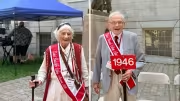
Among the reuning graduates will be Alan M. Garber ’77, Ph.D. ’82, celebrating his forty-fifth. As Harvard’s provost, he has been deeply involved in navigating the pandemic; his class report makes gripping reading on the crisis. But it also reminds classmates about other issues in education, and in life. Of the former, he writes, “[E]very cause of strife in the nation or the world has had an impact here….[O]ur greatest challenge concerns speech: the ability to disagree respectfully and constructively…seems more elusive today than at any time in memory. It is a challenge that our faculty and much of our community are striving to address.”
On life beyond the academy, Garber gently observes, “Now that most of us have qualified for Medicare, everyone thinks we’re senior citizens. Except us. But our bodies are creakier, more and more of us have had brushes with serious illness, and there are fewer of us. Nearly all of us have experienced losses since the last reunion.”
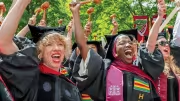
Compared to the Tragedies wrought by the pandemic, the loss of Commencement celebrations in 2020 and 2021 looms small, but those who love the campus in late May resolved to document its missing resonance. Cristina Colette Blau ’87, of the Harvard Alumni Association’s Committee for the Happy Observance of Commencement, began soliciting memories of the great occasion. The resulting HAA volume, Happy Days: Reflections of Commencements Past, collects official and alumni perspectives, plus those of honorands and University presidents.
All-world Harvardian Jack Reardon recalls a recent, more innocent era. In 1990, his first year as HAA executive director, guest speaker Helmut Kohl, the German chancellor, disappeared before his address, “and even his security people couldn’t find him.” He reappeared just before it began, having “walked across the street by himself to buy an ice cream cone.” Tamara Elliott Rogers, who as vice president for alumni affairs and development from 2007 to 2018 became responsible for the whole shebang, wryly perceives it as “a combination of the real Academy Awards, a mosh pit at an arena concert…and a Hogwarts fashion show of exceptional regalia design.”
The last word belongs to the late, beloved Warren M. “Renny” Little ’55. His mock memorandum to the Happy Committee from “The Subcommitte on Atmospheric Conditions,” laid out the weather possibilities for President Lawrence S. Bacow’s installation, on October 5, 2018. Based on its research, “your subcomittee concluded that while ‘it never rains on Commencement,’ this cannot be guaranteed at inaugurations.” Bacow’s big day was clement, perhaps reflecting the spirit Little perceived underlying such University events: “We abide by the statement that ‘It is always fair weather when good folks get together’—calm rising through change and through cumulonimbuses.”
So may it be this May 26 and 29.
~primus vi