
On the sweltering afternoon of July 8, more than 100 onlookers (cell-phone cameras at the ready) crowded Winthrop Street to watch the Lowell House bells descend. After arriving at Harvard 78 years ago as refugees from Stalin’s anti-clerical campaign, the bells were returning to Moscow’s Danilov Monastery. While monks conducted a service, the crowd also got a peek at Lowell’s new Russian bells, resting on a nearby truck bed, waiting their turn to ring out over Cambridge.
Back, but Not to the U.S.S.R.
On the sweltering afternoon of July 8, more than 100 onlookers crowded Winthrop Street to watch the Lowell House bells descend...

Photograph by Jon Chase / Harvard News Office

Photograph by Jon Chase / Harvard News Office

Photograph by Justin Ide / Harvard News Office
You might also like

They Might Be (Harvard) Giants
Two tales of University greats—and an encounter with a Tiger
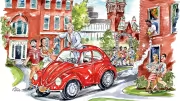
A Harvard President’s VW Beetle That Kept On Giving
Derek Bok donated his car for a good cause.

The Year a Beat Poet Squatted at Harvard
In 1954, Gregory Corso moved into Eliot House. How he stayed there is a literary legend.
Most popular


Explore More From Current Issue

For advocacy and benevolence, three late alumni are reportedly in line for the Catholic Church’s highest honor.

The professor and former Harvard College dean is the next president of Harvard Magazine’s Board of Directors

As humanities shrink across higher education, one department is flourishing. Is its success a fluke, or a roadmap?