If you happened to be outdoors on the Harvard Medical School campus last November, you might have noticed this 78-inch-tall model of a bisected human skull making its way down Shattuck Street by Gordon Hall to a staging area in the basement of the Francis A. Countway Library of Medicine. It was accompanied by a 48-inch-long skeleton of a foot.
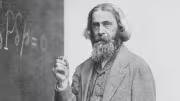
Both were commissioned by Thomas Dwight, A.B. 1866, M.D. 1867, when he became Parkman professor of anatomy at the medical school in 1883. Succeeding Oliver Wendell Holmes, A.B. 1829, M.D. 1836, he had big shoes to fill.
Both skull and foot have been retired from classroom use, but a second giant noggin, built in 1892 and sliced in half horizontally rather than vertically, is still being used to teach would-be physicians something of what goes on in there.
The recently perambulating skull and foot have been loaned to the Collection of Historical Scientific Instruments, in the Science Center on the Cambridge side of the Harvard establishment, where they will be part of Body of Knowledge: A History of Anatomy (in Three Parts), on view from March 6 to December 5, 2014. The exhibit will explore the roles of human anatomy “in scientific discovery, public spectacle, and medical education,” says co-organizer David S. Jones, Ackerman professor of the culture of medicine at Harvard. Items displayed will include astonishing illustrated texts created by anatomist Andreas Vesalius in the Renaissance, wax-injected limbs from nineteenth-century dissection labs, and digital atlases of today.
Down the hall in the Science Center, incidentally, one can examine a recent primitive thinking machine, the all-electronic Harvard Mark IV computer. And out the east door is a monument of sorts to a wise fellow, Winnie-the-Pooh. He, and occasionally some of his associates, were in residence there for many years in a tree (later its stump) and environs (see “In Pooh’s Neighborhood,” September-October 1997, page 77). Pooh left town for a quieter part of the wood some months ago, when Harvard and the City of Cambridge undertook the disruptive but successful construction of the Plaza, just outside the Science Center. Now Pooh has returned—triumphantly, may we suggest. For more about this, you have only to Google “winnie the pooh house harvard.”