It wasn’t until after she moved into the haunted house that Laura van den Berg’s latest novel really started coming together. The Third Hotel follows Clare, a young widow who takes a trip to Havana in the wake of her husband’s sudden death and then begins to see him everywhere. Van den Berg had been batting around a few ideas for a while, loose and abstract but promisingly fertile: the strange pull of solitary travel, the power of tourism to reshape cultures and economies, and the ways people talk about new places. An Orlando native who’d done two book tours in close succession, van den Berg, who is now a Briggs-Copeland lecturer in English, had also started tracking the American tourist boom in Cuba after the United States lifted its travel ban. “So I had all these hazy ideas,” she says, “but I didn’t really understand how they all fit together.”
Then in 2015 she won the Bard Fiction Prize, which came with a writing fellowship—and a house on the college’s vast, pastoral campus, a two-story duplex at the bottom of a small hill with a screened-in porch. Van den Berg is mostly joking when she calls it haunted, but still: There were corners where her dog, normally quiet, would sit and bark obsessively, “like he was seeing something that I couldn’t see.” And the attic stairs kept unfolding themselves into the hallway in the middle of the night. “I would wake up in the morning, after doing my best to make sure the attic was securely closed, and I would find the stairs unfolded there, like some terrible invitation.”
Later that year, a family member suffered a medical emergency, and after receiving the news, van den Berg drove her rental car into a ditch. She wasn’t hurt—the ditch was shallow—but she remembers feeling she had been “dwelling in a slightly supernatural space,” she says. “And also, this lightning strike of grief and a rash action that followed it—that kind of gave way to the world of the book.”
The Third Hotel is van den Berg’s fourth book. In 2015, she published Find Me, a dystopian novel whose narrator is a young woman abandoned at birth, searching for her mother amid a deadly plague that begins with sudden memory loss. The New York Times called Find Me “pleasingly strange” and “impressively original,” and a Salon reviewer declared van den Berg “the best young writer in America.” Preceding the novel came two short-story collections: What the World Will Look Like When All the Water Leaves Us and The Isle of Youth (listed by a dozen outlets as one of 2013’s best books of fiction). Now 35, van den Berg did not begin writing—or even, she says, reading much literature—until her second year at Rollins College, a liberal-arts school just outside Orlando. She signed up for a creative-writing workshop, looking for a straightforward course and finding instead a calling. Among the readings was Amy Hempel’s “In the Cemetery Where Al Jolson is Buried,” and it set van den Berg on fire. She switched majors from psychology to English and after graduation began an M.F.A. at Emerson College in Boston. “So, a hard turn,” she says, “toward this amazing, brutal love.” She arrived at Harvard in 2016, along with her husband, fellow fiction writer and Briggs-Copeland lecturer Paul Yoon.
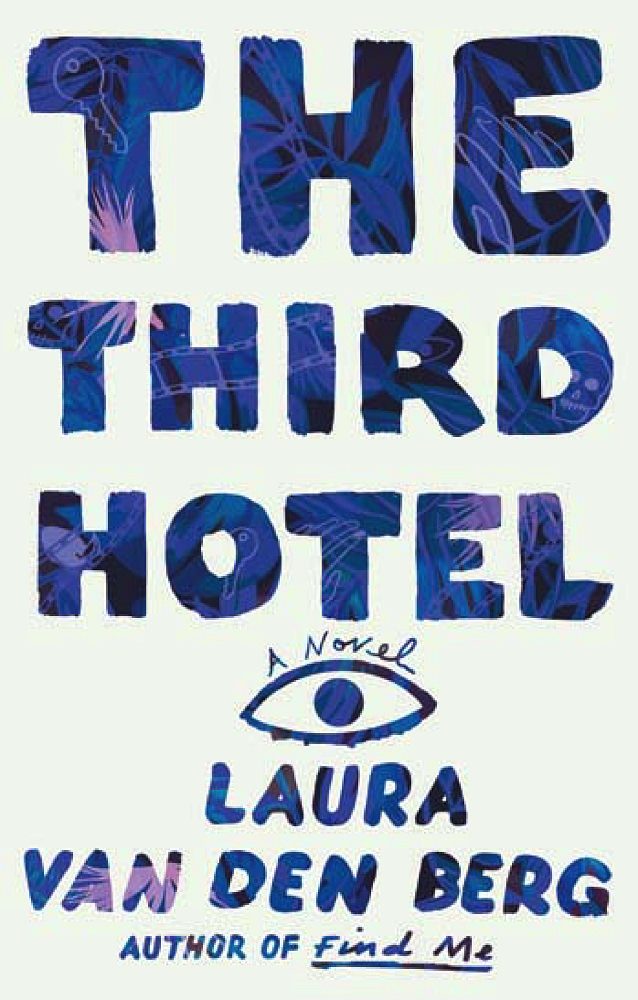
In the novel, Clare first catches sight of her dead husband outside the Museum of the Revolution, wearing a white linen suit she’s never seen before and looking up at the sky. The trip to Havana had been meant for the two of them; her husband, Richard, was a horror-film scholar, and they’d planned to attend a festival showing a Cuban zombie movie called Revolución Zombi. She begins following him through the city, watching him buying mangoes from a fruit market, eating alone in a spare apartment, reading the newspaper at a café, drinking at a bar.
Dreamlike and mysterious and almost hypnotically absorbing, The Third Hotel is a moving exploration of grief and marriage. Experimenting with horror-film tropes and dynamics, van den Berg also mines sharp, subtle insights on gender and misogyny, art, loneliness, the afterlife.
A casual horror fan since childhood (“I’m one of those weird people who finds terrifying myself in a really scary movie to be cathartic and relaxing”), she became a bit of a horror-film scholar herself while researching the novel. “Good horror gets to the heart of some really difficult human stuff,” she says. “Death and the afterlife, and what, if anything, awaits us on the other side. And also: the way that what you’re blind to—willfully blind to—can unravel your life. That your secrets, your betrayals, your crimes—there comes a time when you have to reckon with the consequences.” Horror also explores how human crime can manifest in a large-scale social way. “Zombie films have been a really powerful medium for exploring social questions, questions of social violence, historical violence, historical trauma. All this is marrow-deep in horror.”
The Third Hotel also owes its surreal aesthetic to van den Berg’s childhood in Florida (Clare has roots there, too), where “the pedestrian and the deeply strange are always afoot,” she says. She remembers on one hand the bottomless teenage boredom of wandering suburban malls and driving around endlessly. And yet “on the other hand, the uncanny is always there. Florida is a place of extremes: the weather is very extreme—the heat, the storms—and nature is very extreme.” Any body of water larger than a puddle is likely inhabited by alligators, and the animals were forever lumbering into her family’s yard and climbing trees. “It took me a really long time before I could embrace swimming in a lake in New England without worrying about getting eaten by something,” she admits. Meanwhile, her parents, both raised rural, kept a running zoo in the house: cats, dogs, snakes, fish, ferrets, hamsters, chickens, and for one year a wolf named Natasha, with piercing blue eyes, which they adopted as a pup on a family trip to Utah. “I like making work where the uncanny and the ordinary are intertwined,” she says. “That doesn’t feel alien to me; it feels real.”